Wet Felting With Children, The Colour Monster Comes to Life
From Story to Wet Felting With Children
Sometimes the best lessons in colour come from a story about feelings. They also come from a bundle of soft wool roving, and a classroom of children eager to get their hands wet and woolly. This is a story about wet felting with children.
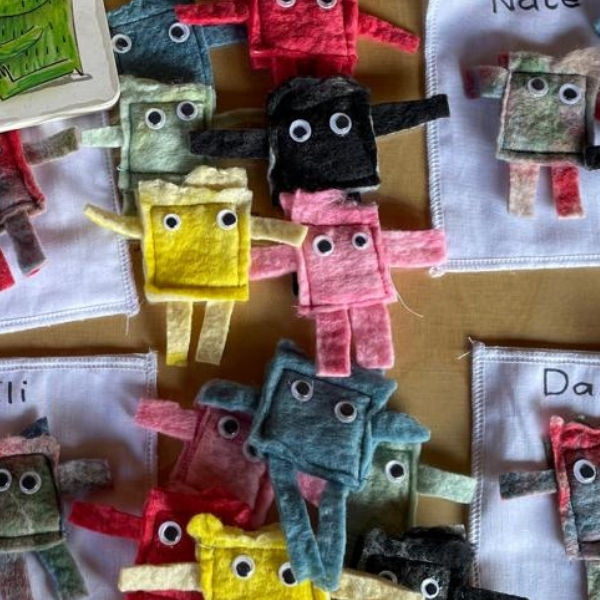
Our friend Michele, of Michele Felts, is a nursery school teacher and felting artist. She recently shared The Colour Monster, written by Anna Llenas, with her class. The book tells a story where each emotion has its own colour. The children loved the story so much that they wanted to make colour monsters of their own. What followed was a beautiful wet felting journey using ColourSpun roving. It ended in a row of little felt friends ready to go home and help with emotional regulation.
Michele documented the whole process of wet felting with children for the parents in her class. She has kindly let us share it with you, in her own words.
We read The Colour Monster, a book about feelings. Each emotion is represented by a colour. The class decided to make colour monsters of their own, so the process began. Soft, genuine wool roving was crafted into felt, and the felt was then transformed into monsters.
First, the basic equipment needed is pretty simple: wool roving, which is minimally processed wool, hot water, soap, spray bottles, bubble wrap and tulle, and anything else that can be used to rub the wool.
Yellow roving for our happy monster.
Next, the wool is pulled into small bunches of fibres and laid down on the bubble wrap in three layers, vertical, horizontal and vertical again. It is then covered with a piece of tulle.
Now the fun begins. The fibres are sprayed with hot soapy water and then rubbed very gently in order to felt them. As they begin to felt, they are rubbed more forcefully until a piece of wool fabric is formed.
Once felted the soap is rinsed out of the fabric.
And finally the fabric is laid out to dry.
With the felt now dry, this wet felting with children project was ready for its final, favourite part.
Bringing the Monsters to Life
Once the little monsters were cut and sewn, it was time to add eyes.
And here we have the end result, all ready to go home and help us with emotional regulation.
With thanks to Michele, of Michele Felts, for sharing this lovely project with us.
Frequently Asked Questions
What is wool roving? Wool roving is wool that has been minimally processed, leaving it soft and easy to pull apart by hand. It is the starting point for wet felting projects like this one.
Can children do wet felting safely? Yes, wet felting is one of the gentler felting techniques and works well with children, since it uses hands, water and soap rather than sharp needles. Adult supervision is still recommended, especially with hot water.
What is the difference between wet felting and needle felting? Wet felting uses water, soap and friction to bind wool fibres together by hand. Needle felting uses a barbed needle to lock fibres into shape, which is a drier process. This project used wet felting.
Do I need special wool for felting projects like this? Not all wool felts equally well. Roving suited to felting, like the kind used in this project, is chosen because it locks together easily when wet and agitated.
✕
Scroll to Top
Your free ColourSpun Creative Companion is waiting.
A practical crafter’s reference with yarn weight guides, needle and hook size charts, knitting and crochet abbreviations, skill level checklists, care instructions, grid paper and a project planner. Yours free when you join the ColourSpun community.
Be the first to hear about new colours, studio news and things we think you will love.
We respect your inbox and your privacy. Unsubscribe anytime.